The B2B Secret: How Building a Brand is the Ultimate “Growth Hack”
On average, 95% of B2B buyers are not currently “in market,” meaning that they are not actively looking for or considering whether to buy a given type of product. As a result, most marcom activity needs to focus on getting remembered by those 95% so that they will think of you when they need your type of solution in the future. That means getting your product “top of mind” and placed on the day one “consideration list” thats are created by buying committees. Most will end up buying one of the products on those shortlists. In this talk, Samuel will discuss the benefits of a strong brand, product marketing versus brand marketing, the importance of mental availability and brand equity, examples of good B2C and B2B branding, how to build a brand, and how to manage and measure mental availability brand equity. After all, B2B marketing is more similar to B2C than people think.
Actionable takeaways:
— Understand the importance of brand equity and how strong brands lead to greater revenue and profit, more sales pipeline in the present and the future, greater conversion rates, higher prices, and overall valuations.
— See how to build mental availability and brand salience among the 95% of B2B buyers who are not in the market right now so that they will remember you when they want to buy a product in the future.
— Learn the step-by-step process of brand positioning, brand codes, brand objectives, brand architecture, tactical execution, budgeting, and tracking.
What This Speech Covers
For more detail, please read these B2B columns of mine in The Drum:
First: Should B2B content marketers focus more on advertising? Second: An exclusive look at new B2B marketing research Third: Brandless and branding.
Presentation Preview and Excerpts
Now, when most people discuss or use marketing funnels, they usually make them too simple or too complex to be useful. The simple ones are just copied from marketing textbooks and do not say anything specific, precise, or useful. Seriously, if I am talking with an agency, and they start saying that my company needs “MOFU content,” I immediately know that they have no idea what they are talking about. I just hope that no one here is like that. At the other end of the spectrum, wannabe thought leaders create complicated, insane funnels usually as a way to supposedly prove that the “funnel is dead” even though that is certainly not true. It just shows that they do not know how to create a good, usable funnel.
Only slightly better is a web traffic funnel. Over the past twenty years, everyone has increasingly been using something like this as the end-all, be-all of marketing. You simply have website visitors, signups, and paying customers. Marketing is pushed only to get more and more clicks to a website and to increase the conversion rates between the next two steps. This SEEMS very linear and logical to CEOs, CFOs, and investors. But there is one problem: It’s not how buyers actually behave in the real world. People who use only a web traffic funnel organize their work based on what looks good in a spreadsheet. Online analytics and web traffic funnels are reporting tools. They are not diagnostic tools. They are not purchase funnels that specifically diagnose the situation and tells you what needs to be done.
To use the ideas of brand and performance effectively, you first need to know how to create and use a good purchase funnel rather than a web traffic funnel. So, what is a purchase funnel? The overall purchase path for your specific category or industry or company. Each step is something specific and measurable that the people or companies think or do. Creating an actual purchase funnel rather than using only a web traffic funnel will give you more strategic insights, better tactical plans, and greater overall results.
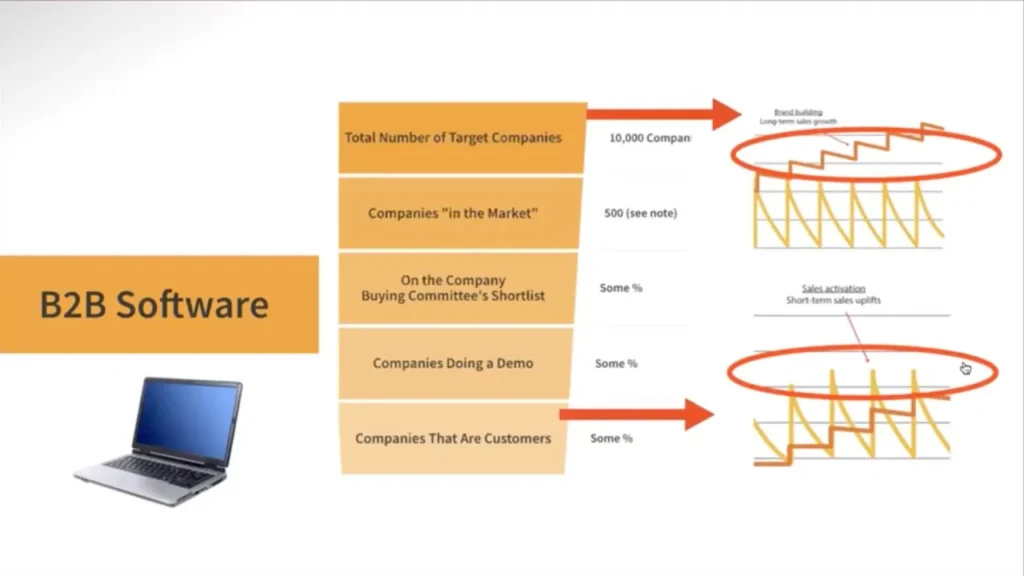
Now, most of my experience is in B2B software, so here’s an example from there. You have the total number of companies in the target segment, the percentage who are currently “in the market” and looking for solutions like yours, the percentage whose buying committees have shortlisted your software, the percentage who are doing a demo of your software, and the percentage who are paying customers. Again, the percentage numbers will go down the funnel at each step. Note: On average, only 5% of all B2B companies are even in the market for a given type of product at any given time. Now, after you’ve created a purchase funnel, it’s time to go on to the next step.
First, I like to talk to sales and talk to customers to get a good idea of the specific purchase funnel before doing any additional broad market research. That way, you know what questions to ask in your research in the context of your newly-created funnel — particularly to get the current top-funnel metrics. Then, use Google, your research, or any other decent source to get a general number for your total market or segment at the top of the purchase funnel. Then, use your research, your CRM, and anything else to populate the numbers at each step of the funnel. At this point, you’ll have a basic diagnosis of where you stand currently.
Then, you can use that information to decide on which part of your purchase funnel you will focus your marketing efforts. This is part of strategy. Usually, you will want to focus on the part of the funnel that sees the biggest drop-off. This tells you where you are blocked in the market in actual human terms — it’s far more useful than just saying “we need more website traffic” or “we need better conversion rates” in a web traffic funnel. Take my B2B software funnel example. Maybe the drop-off is in not making buying committee shortlists. Maybe it’s end users doing demos but not signing up. Again, that will tell you the specific strategic objective you need to accomplish.
Here’s the key to remember: A purchase funnel is not about tactics and details. Different doctors or software buyers might do different things within each step of the funnel. But in general terms, it’s about the overall process that all go through. Pick the strategic objective first and then think about tactics later. A software buyer will not buy unless they do a demo first. They will not do a demo unless that software is on the buying committee’s shortlist first. A buying committee cannot shortlist you unless they both have first already heard of you and they are actively in the market and looking for your type of software.
And then you can translate that strategy into a good, actionable brief for your internal staff or external agencies. Let me explain. When I have been both in house or at agencies, I have seen too many vague, terrible briefs. The stated goals are “get more leads” or “make our brand more trusted” or something like that. For the benefit of both your companies and your agencies, you need to do better. We need to stop giving vague, wishy-washy goals to our internal teams and external agencies.
Perhaps the best benefit of having a good purchase funnel with numbers is that you can assign what are called SMART metrics to your internal teams or external agencies. Give them a specific, concrete target to hit. That is the best way for them to deliver what you need and to make you look good to your boss. SMART metrics are specific, measurable, attainable, relevant, and time-bound. For example, as you can see in these two examples: Increase the number of people diagnosed with existing high blood pressure by 10% by the end of 2026. Increase the number of in-market companies that shortlist our software by 200 by the end of Q2.
So, create a purchase funnel, populate it with the current numbers, decide where in the funnel to focus, create a SMART metric for your funnel-based objective, then have your internal teams or external agencies create a tactical marcom plan to achieve that objective. Now, once you’ve made the strategic choice on which step of the purchase funnel to focus and what specific number you need to hit, then you make the tactical plans of what to do to achieve that specific objective.
For B2B software, if you want to get more companies “in the market” to look for a solution to a problem or need, you might wants ads, event booths, or PR. If you want to encourage more buying committees at companies to shortlist you, you might use ABM email campaigns or private events to curry favor with those executives and then measure TOMA (Top of Mind Awareness) later. If you want to increase the percentage of demos to closed deals, that’s where salespeople come in.
Remember: There should not really be a division between sales and marketing. Remember the Promotion Mix within marcom — salespeople are just one type of marcom tactic that you can deploy. If you’re targeting a segment of people, you can target them with ads, you can target them with salespeople, or other things.
In B2B software, you might get some quick sales by pushing and pushing companies that have done demos to sign the sales contract. But the real money over the long term will come from getting all, say, 10,000 companies in the segment down and down the funnel to that point. Again, that takes time. Binet and Field’s whole point is that in every context, you need to split your time and resources and budgets between the short term and long term to get sales both today and tomorrow. What exactly you should do and how much you should spend where just depends on your specific context. It just depends on your purchase funnel and what its current metrics are today.
But as many of us have probably seen at our companies, everyone thinks only about the short term today. CEOs want more sales, leads, and money today. They’re not thinking about tomorrow. But I’ve always put it like this: You can take all the easy, low-hanging fruit at the bottom of the tree today. But if you don’t plant the seeds to grow more fruit tomorrow, then you’re going to go bankrupt tomorrow because there won’t be any more fruit to pick. It’s always about balance.
Here’s a great story on LinkedIn. Now, I’m going to do the one thing you’re not supposed to do during a presentation — read from your slide. But I will this time because it’s very important. Please listen.
“I spent three years as a CRO with marketing reporting to me. We hit out numbers. The board was happy. Our attribution looked clean. But over time, I realized something about marketing. We were hitting our short-term goals while quietly stripping marketing of its purpose. When marketing reports into sales, measurement becomes a filter. “Everything is judged on short-term pipeline impact. Campaigns that don’t convert fast enough disappear.
And without meaning to, you stop speaking to 95% of your market, the people who aren’t ready to buy yet but will remember you when they are. I still remember one campaign that showed this clearly. It ran for 90 days, targeting new accounts in our key segment. Pipeline impact? Almost none. But six months later, those same accounts started showing up in inbound forms, webinars, and sales conversations. The campaign hadn’t failed, our lens of measurement had. That experience changed how I think about marketing and data.
If marketing wants to stay strategic, it needs to take back ownership of how results are captured and shared. It starts with knowing what to measure. Not every touchpoint leads to revenue right now, but every meaningful interaction contributes to it.” Ladies and gentlemen, there you have it, and there you are.
Historically, brand building has never been a priority in B2B — at least not in the SaaS world. The goal is often simply to spam people by other names and push and push them to signup or talk to a salesperson.
In the US in the ’80s and ’90s, there was the famous tagline, “no one ever got fired for buying IBM.” That same idea holds true today. Your targeted end user might love your product and all your great features, but you’re dead in the water if you don’t pass the committee. And the committee won’t shortlist you if they’ve never heard of you in the first place.
Here are some general principles based on the latest research. Again, the links to sources are at the bottom right. Remember the purchase funnel that I mentioned. An end user has a problem or need. They then go to the buying committee. They together make a shortlist of options — usually based on companies that they already knew from long before there was a need for them. 90% of the time, the winning company is on that shortlist and deals are often won or lost before a company ever talks to a salesperson.
I will phrase that differently — companies have usually already decided who they will buy before they talk to a salesperson. As a result, if you don’t focus on the top of the funnel, you’ve already lost out on 75% of future deals. Now, do you see in this example as well why the top of the funnel is important? Because the number one concern among B2B buying committees is NOT how your features and prices compare. It is one question: “Will I feel safe signing a contract with them?”
So, how should you frame top of the funnel work in B2B? It’s actually not that far off from B2C. You need three things: Distinctive brand assets, category entry points, and a creative that is right-brained and emotional. Oh, a category entry point is another term for use case or Job To Be Done.
In this next video, I will show a lengthy ad for an HP cybersecurity solution. The distinctive brand asset is Christian Slater, a famous middle-aged actor from the ’80s and ’90s who is well known by the middle-aged managers in the US who would buy these products. Pay attention to all the category entry points — the times that you are especially vulnerable to attackers. And he delivers an emotional message as The Wolf.
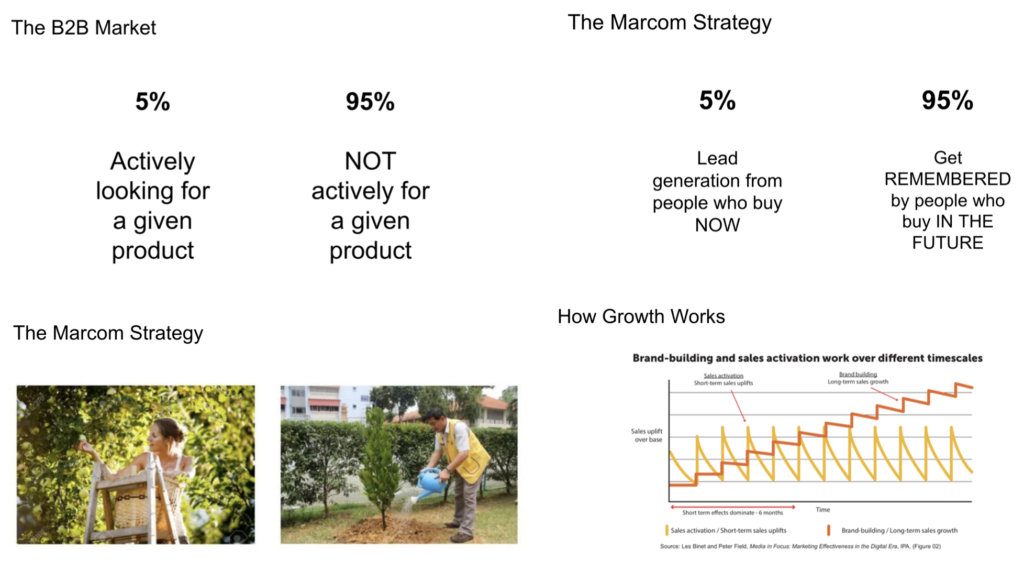
On average, only 95% of the market is actively looking for a given solution. That means that 5% of the market should be targeted with direct response, lead generation, and sales efforts. The other 95% should be targeted with marcom that aims to get the company remembered for when those 95% do want to buy in the future. Of course, quick leads and sales are important for survival and growth in the short term. But the most growth in the future comes from building a brand among all potential category buyers.
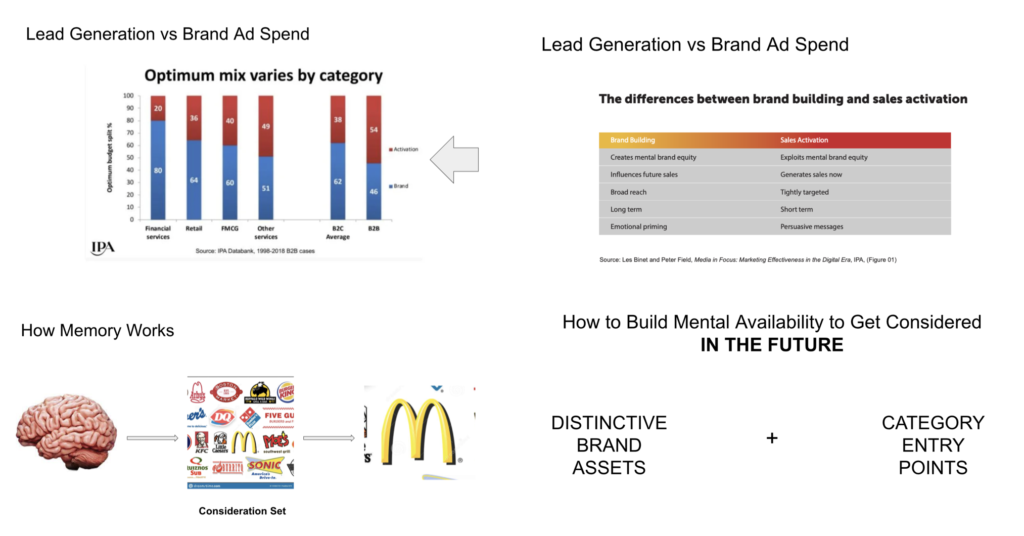
To achieve both short-term and long-term B2B marketing goals, marcom spending must be divided into two categories: activation and brand. On the brand side, marcom must focus on people, be a little more emotional, and build mental availability — it tells people what to think and remember over the long term. Conversely, activation spend tells people what to do (click and become leads) right now.
When a person wants to buy something, his brain comes up with a list of options that are “top of mind.” This is a consideration set. The goal of brand advertising is not just to build awareness that you exist — it is to build enough mental availability so that you are in everyone’s consideration set in the future. If you are not in the consideration set in the beginning, you will never be bought at all. The goal of B2B brand advertising is to create memorable ads that use both distinctive brand assets and speak to the times when people start thinking about buying the category (these are called category entry points).
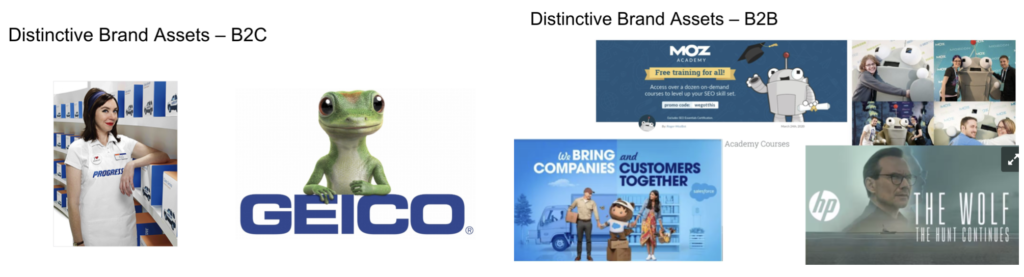
Over millions of years, our human brains have evolved to recognize and remember people, characters, and particularly faces. Building and using such distinctive brand assets is the best way for your company to get remembered.
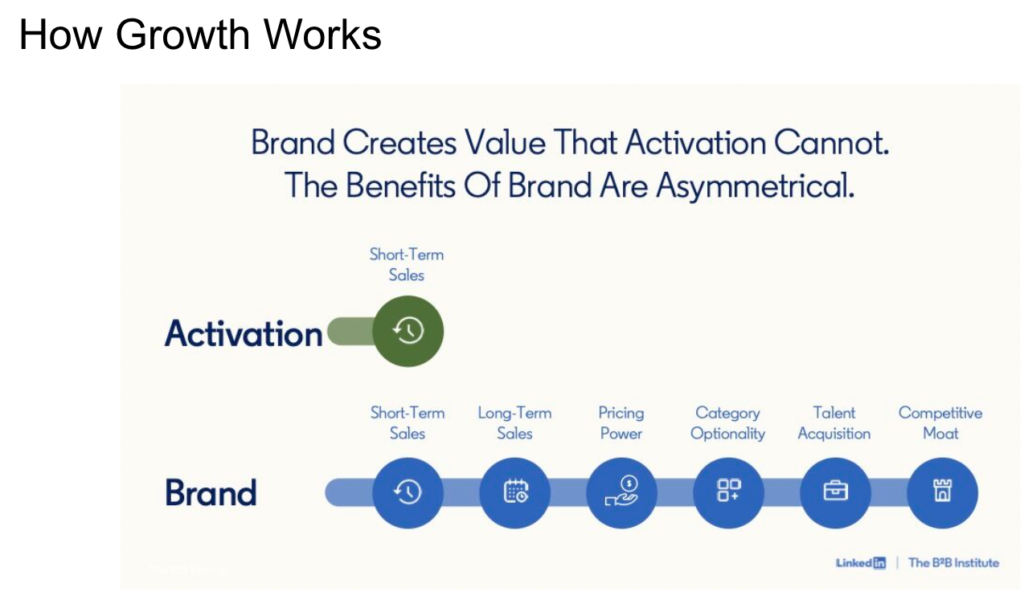
Activation certainly gets leads in the short-term. But building a strong brand throughout the entire category gets leads today and leads tomorrow along with increasing pricing power, talent acquisition, and more.